Effective oversight of service interactions through call center monitoring helps organizations maintain high standards and foster stronger customer relationships. A strategic approach to call center monitoring ensures consistency, accuracy, improved agent performance, and long-term operational growth.
- Implementing structured evaluation processes allows businesses to identify recurring pain points that impact the user experience.
- Standardized data collection measures provide clarity on how well representatives adhere to established communication protocols.
- Real-time visibility into active queues helps supervisors address performance gaps before they evolve into significant service bottlenecks.
- Integrating analytical tools enables leadership to track long-term trends and adjust service objectives based on actual interaction patterns.
- Selecting an experienced provider helps organizations achieve scale while maintaining quality across all channels and communication platforms.
Common Service Challenges That Call Center Monitoring Solves
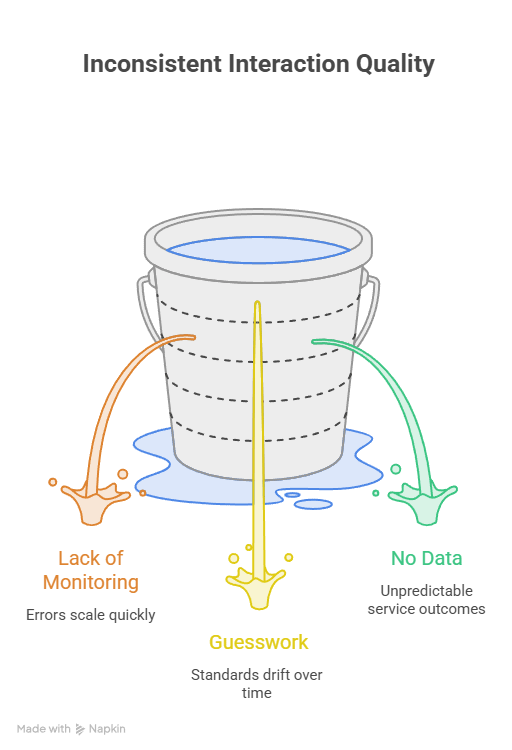
Many organizations struggle with maintaining consistent interaction quality across various communication channels. Without systematic Call Center Monitoring, it is easy for small errors in tone or process to scale quickly, eventually damaging brand reputation. The primary goal of establishing an oversight program is to capture these gaps early and prevent them from becoming systemic issues. When businesses rely on guesswork rather than data-driven insights, internal standards often drift over time, leading to unpredictable service outcomes.
Another significant challenge involves the loss of visibility into the customer journey when operations are distributed. Managers frequently lack the context needed to understand why specific inquiries lead to repeat calls or customer dissatisfaction. By utilizing call center monitoring to track audio and transcript data, leadership can objectively evaluate the root causes of friction. This process eliminates the ambiguity that often surrounds agent performance and allows for targeted coaching based on concrete examples.
Finally, maintaining regulatory and operational compliance remains a constant priority for businesses in every sector. Without a formal review process, agents may inadvertently omit mandatory disclosures or fail to follow internal verification procedures. Proactive monitoring functions act as a necessary safeguard, ensuring that every interaction aligns with legal requirements and company policy. This structured oversight model mitigates risk while providing the accountability required to maintain reliable service delivery.
How Call Center Monitoring Improves Outsourced Customer Support
Outsourced support teams often face the difficult task of representing a brand they may not interact with daily. To bridge this gap, businesses implement rigorous quality standards that guide third-party agents through complex service scenarios. For instance, companies often utilize 9 essential benefits of specialized support to ensure that their external partners align perfectly with their unique organizational goals. This alignment is not automatic; it requires ongoing calibration of tools and expectations.

When evaluating the effectiveness of these partnerships, managers rely on specific performance categories to determine success. Clear documentation of these benchmarks prevents miscommunication and keeps external teams focused on high-priority outcomes. The following table illustrates the common areas evaluated during routine quality reviews:
| Evaluation Category | Impact on Service | Priority Level |
|---|---|---|
| Tone and Empathy | Improves customer trust | High |
| Resolution Speed | Reduces wait times | Medium |
| Process Accuracy | Maintains compliance | Critical |
These performance categories provide a clear framework for benchmarking success across outsourced operations. By shifting the focus from subjective feelings to measurable evidence, leadership can maintain control over service quality regardless of where the workforce is located. This transparency ensures that service remains professional and that the external team feels fully integrated with internal goals and standard procedures.
Call Center Monitoring Metrics That Matter Most to Business Leaders
Business leaders must prioritize metrics that provide a comprehensive view of operational health rather than focusing on volume alone. Efficiency metrics are helpful for resource planning, but they rarely tell the whole story regarding customer satisfaction or long-term loyalty. When leaders rely on call center monitoring software to aggregate data, they can shift their attention toward indicators that matter most to client outcomes. Distinguishing between vanity metrics and true value drivers is the hallmark of a data-informed organization.
Key performance indicators typically include first-contact resolution rates, sentiment analysis scores, and protocol adherence percentages. These numbers act as a baseline, providing a snapshot of operational health that can be shared across management teams. However, the true value lies in the qualitative feedback that accompanies these figures. When numbers are synthesized with context, leadership can confidently make adjustments that significantly enhance the overall experience for every customer involved.
To ensure team performance remains elevated, leaders should focus on several specific areas during their periodic reviews:
- Average time spent on each interaction to monitor potential inefficiencies.
- Percentage of successful resolutions achieved within the initial contact period.
- Sentiment scores that reflect the emotional outcome of customer conversations.
- Compliance with mandatory disclosure requirements across all support channels.
Technology Trends Shaping Modern Call Center Monitoring
Artificial intelligence is transforming how organizations monitor operations by delivering automated insights that would be difficult and time-consuming to uncover manually. Modern call center monitoring software now utilizes speech analytics to flag potential issues in real-time, allowing supervisors to intervene exactly when it is most beneficial. These technological advancements enable teams to scale their review processes significantly, moving from assessing only a tiny fraction of interactions to analyzing nearly every conversation that takes place.
Beyond simple transcription, new platforms can interpret tone, speed, and linguistic nuance to gauge customer sentiment more accurately. This capability removes the manual labor traditionally required to categorize interactions, allowing managers to spend more time coaching agents. By automating the data collection phase, organizations can focus their intellectual resources on designing better workflows and refining their response strategies to meet modern expectations.
Seamless integration has become essential as modern platforms connect effortlessly with existing customer relationship management systems, creating a more unified customer experience. A unified view of the customer is essential for providing informed, accurate support in high-stakes situations. As technologies continue to mature, the focus is shifting toward predictive analytics that can alert managers to trends before they negatively impact service levels. This proactive stance on performance management ensures that systems remain agile during periods of rapid growth or market change.
Finding the Best Call Center Monitoring Provider for Your Business
Selecting a provider requires careful attention to how their services adapt to unique company needs rather than a one-size-fits-all approach. Businesses should choose partners that provide transparent reporting and customizable evaluation criteria to align with evolving goals and performance expectations. It is also important to seek out experts who prioritize improving monitoring practices over simply checking boxes, as these partners provide more long-term value to their clients.
During the evaluation process, ask potential providers how their tools facilitate objective scoring and whether they support the specific communication channels your business employs. A partner that offers seamless integration will simplify the workflow for your internal team and prevent data silos. The goal should be to find a long-term collaborator that evolves alongside your company, providing consistent insights that lead to higher satisfaction and operational precision.
If you are prepared to elevate your customer support standards, Contact us to discuss how our systems can support your specific requirements. We focus on providing actionable data and reliable support structures that empower your team to excel. Working with a dedicated provider allows you to move away from tedious manual assessments and toward a streamlined system that rewards performance and ensures quality in every client interaction.
Conclusion
Prioritizing a structured monitoring process is essential for any organization that values high-quality service and long-term customer success. By combining objective metrics with deep analytical insights, businesses can turn each interaction into an opportunity for growth and refinement. Consistent attention to detail strengthens compliance, improves operational efficiency, and promotes a culture of continuous excellence across the entire service organization.
Frequently Asked Questions
How does call monitoring help improve customer satisfaction?
It helps by identifying specific points of friction within interactions so that agents can refine their approach, solve issues faster, and ensure that every customer feels heard and understood.
Can automated tools replace human quality oversight completely?
While automation significantly increases coverage and analytical depth, human judgment remains necessary to interpret emotional nuance and provide the empathy-based coaching required for effective team development.
How many calls should be monitored effectively?
Modern best practices advocate for monitoring as high a percentage of calls as possible, ideally using automated analysis to cover the entire volume rather than relying on a small statistical sample.
What role does sentiment analysis play in monitoring?
Sentiment analysis provides a quantifiable way to track how customers feel during and after an interaction, helping leadership understand brand perception beyond basic efficiency metrics.
What are the most common indicators of a successful monitoring program?
Success is typically marked by improved first-contact resolution rates, increased agent confidence through targeted coaching, and higher overall satisfaction scores from the customer base.
Why should managers be involved in the monitoring process?
Manager involvement ensures that performance data is directly connected to coaching and strategic planning, creating a clear link between review outcomes and tangible service improvements.
How often should quality standards be updated?
Quality standards should be reviewed periodically to reflect shifts in brand goals, customer expectations, and any changes in the regulatory environment, ensuring they remain relevant and effective.